

I’ve never really been much of a girl who mandates herself and her houseguests to use coasters on the tables. How often are we drinking in a condensation-inducing environment? Rarely. Plus, coasters are usually weird looking and always in the way. At least in my experience. The coaster exception has to be made this time of the year, when even my can of root beer can go from chilled to matching the air temperature in <5 minutes. Much of the furniture we use right now is accepting of the water rings left behind, but working at home in the summer months has made us witness to a few pieces that don’t bode as well.
And so, I sucked it up and made some coasters. Portland cement coasters, to be exacting. That’s right, skim past the ceramic tiles, pour past the cork squares, forget about the collection of cardboard circles I could have easily borrowed (indefinately) from the bar. Instead of all that, I wanted to try and make some rough little cement coasters for, specfically, the laminate dining room table and the painted sunroom table.

I followed through on this project in a cheap-o way. I had the portland cement (from when I made the cement pots last summer and the heart doorstop in February), but in order to create round coasters, I needed a good mold. I considered using the inside of a masking tape roll, but the rolls I had were a little too small. Cookie cutters, too irregularly shaped. Everything else, too nice to ruin with cement. Instead of something obvious, I turned to a different department (on our basement supply shelf) and pulled out this half-package of vinyl foam weatherseal, a 3/8″ wide and 3/16″ thick strip of tape that’s used to help insulate doors.

With a manufactured tendency to want to coil perfectly, the weatherseal seemed like an obvious answer. It was strong enough to stand upright, and it would be flexible enough to be easily removed from the dried coaster. To lock the weatherseal in place, I overlapped and wrapped the ends with a pinch of masking tape.

I retrofitted the flattest and smoothest surface I could find, that being a few pieces of marble that was scrap from the bathroom shower shelves, and wrapped each piece with Saran Wrap. How domestic. The portland cement itself is smoother than a lot of rockier/grittier formulas, and therefore it’s more prone to pick up every last nick and bump in whatever surface it dries against, so the marble really was a perfect solution for ensuring that at least one of the sides of the coaster was really smooth, not wonky and bumpy.

With the cement mixed (in a old dirty piece of tupperware), I began spooning it into the forms gently, letting it flow however it wished and level out a little bit before adding the next scoop.

The cement wasn’t very runny, kind of like the consistency of thick relish. Nothing else comes to mind, we picnicked all weekend. The best resulting coasters were from the molds that I filled to the brim. You’ll notice when you’re working with cement at home that within just a few minutes, the heavier mixture sinks to the bottom of the mold and the moisture levels out the top. You can already see it happening in this next picture even as I continue to scoop in more cement.

For the most part, the molds held in all the moisture really well. The one on the right in this next picture was a gem. The one on the left was a little leakier, but not detrimentally, and probably only because it wasn’t assembled to sit as flush as its counterpart.
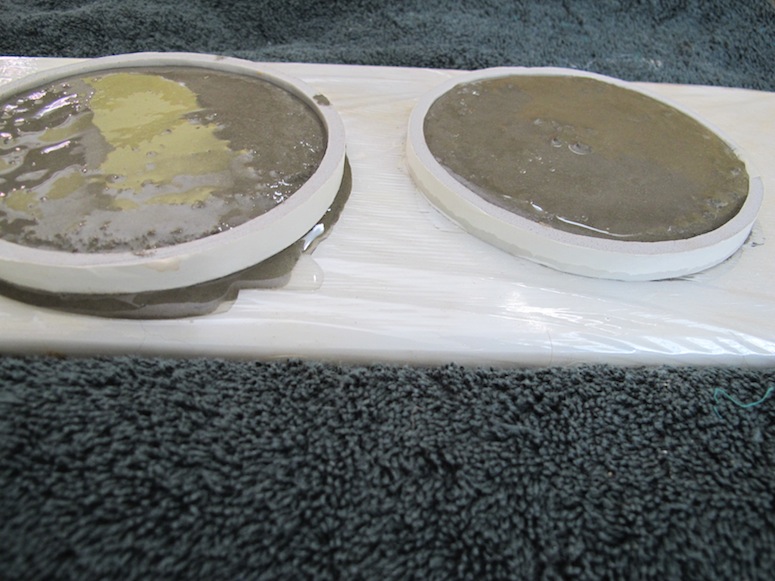
I did a few batches of three over the course of a few days. I found that the coasters were best left untouched for at least 12-hours, and then left sans mold in the sunlight to finish curing throughout for another day or so. A few batches were thick, a few batches I experimented with thinner coasters in which the cement only filled about half of the 3/8″ height of the mold.

And the thin ones were all well and cute, kind of like the crispy “snow cookies” we feed Cody after heavy snowfall, but their fragility was very apparent. First it was one.

And then, once I got sanding them lightly and gently, two more joined.

*Note: Breathing in cement powder isn’t good for the lungs. Work in a well-ventilated area and wear a mask and goggles. I am, it’s just not shown because the moisture-inducing-behind-the-goggles combo makes me look ridic.
You’ll find that sanding them down doesn’t take much muscle. Any bumps and divots are leveled out pretty easily, eliminating any irregularities and making a nice smooth surface for your bevvy to sit upon.
We tested them out while we worked in the sunroom yesterday. Verdict? Excellente. And easy on the eyes too. The coasters. And Pete too, I mean.

Side note: New tumblers. From Target. Happy dancing.
Overall, I had 5 coaster fatalities 4 survival stories. All three of the thick coasters made it through wonderfully and would probably only break if I slammed it against the edge of the table. The thin one that survived is a little fragile, but seems fine in use.
As evidenced by the number of water marks on the living room coffee table/trunk, I think the new coasters will get a lot of wear.

Try them for yourself!


Leave A Reply